
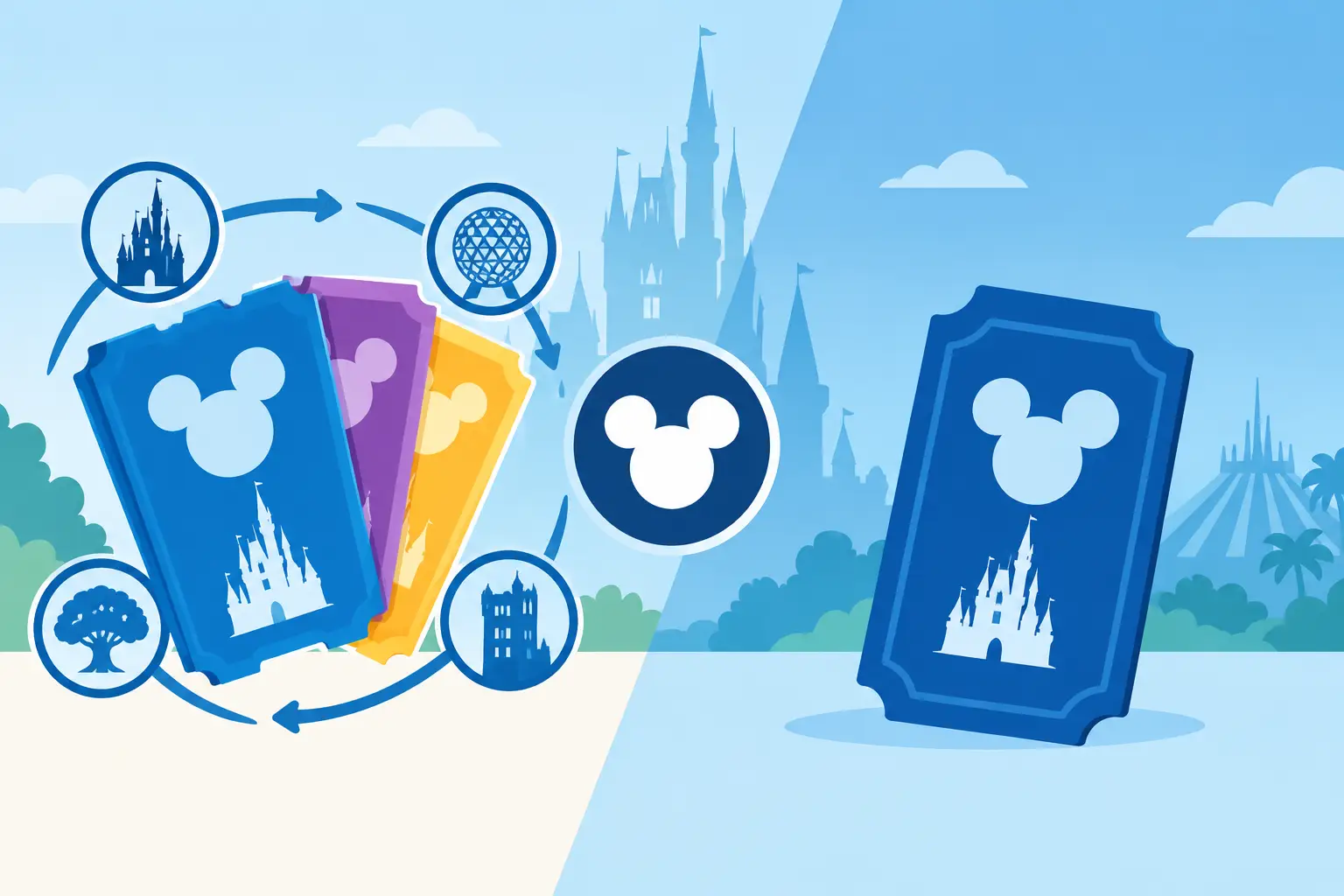
A Park Hopper upgrade sounds like the flexible choice, but flexibility only has value if your itinerary can use it. In the Disney hopper versus park tickets decision, the wrong choice is usually not a bad ticket - it is paying for movement you will not realistically make, or limiting a short trip that needs it.
For most first-time Walt Disney World visitors, standard one-park-per-day tickets are the better starting point. They create an easier touring plan, reduce transportation time, and keep the budget focused on the parks themselves. Park Hopper tickets make more sense for travelers with limited park days, repeat visitors, adults who enjoy dining and evening entertainment, or families using a deliberate split-day plan.
Disney Hopper Versus Park Tickets: The Core Difference
A standard Disney theme park ticket admits you to one park per day. You choose among Magic Kingdom, EPCOT, Disney's Hollywood Studios, and Disney's Animal Kingdom, then spend that day at that park. You can leave and return to the same park, so a midday hotel break is still possible. What you cannot do is visit a second Disney park that day.
A Park Hopper ticket adds the ability to visit more than one Disney park on the same day. You may start at one park, then head to another later, subject to the ticket rules and operating conditions in place for your dates. The upgrade is purchased for the length of the ticket, not just for one convenient day, which is why its value can disappear quickly on longer vacations.
The practical question is not whether hopping is nice to have. It is whether multiple parks in one day will make your trip better enough to justify both the upgrade cost and the time spent moving between parks.
When Standard Park Tickets Are the Smarter Buy
One park per day is the cleanest choice for most families, especially on a first Disney trip. Each park has enough rides, shows, meals, character experiences, and walking to fill a day without making the schedule feel slow. Magic Kingdom and EPCOT in particular reward a full-day approach.
Standard tickets also work well when you have four or more park days. With one full day assigned to each park, there is little operational need to hop. A fifth or sixth day can go to the park your family most wants to repeat, which is often more relaxing than trying to combine two parks simply because the ticket allows it.
This option is especially effective for travelers with younger children. Moving hotels, strollers, snacks, and tired kids between parks can cost more energy than it saves. A family that starts at Animal Kingdom at rope drop and plans to end at Magic Kingdom may find that the transfer, security screening, and reset time turn an ambitious plan into an overtired evening.
Budget-conscious visitors should also start here. The Hopper add-on is a fixed additional cost layered onto every ticket day. If you only plan to hop once during a five-day ticket, you are paying for a feature you barely use. That money may be more useful for a character meal, a resort rest day, paid transportation, or simply reducing the overall vacation total.
When a Park Hopper Can Be Worth the Extra Cost
Park Hopper tickets earn their keep when they solve a real itinerary problem. The clearest example is a short trip. If you have only two or three Disney days but want meaningful time in all four parks, hopping can help you cover the lower-priority parks without sacrificing full time at your favorites.
Animal Kingdom is commonly paired with another park because many guests can complete their must-do attractions there in a morning or early afternoon. That does not mean the park is a half-day park for everyone. Pandora, shows, animal trails, dining, and a slower pace can easily fill a full day. But for guests focused on a concise attraction list, moving to EPCOT or Hollywood Studios for dinner and nighttime entertainment can be an efficient use of a Hopper.
EPCOT is another strong hopping destination, particularly for adults, couples, and groups with older children. You might spend the morning at Hollywood Studios for headline rides, return to the hotel for a break, then enter EPCOT for a festival meal, World Showcase, and an evening in the park. That is a purposeful use of the upgrade, not a rushed attempt to check boxes.
The Hopper also gives repeat visitors freedom to follow lower wait times, revisit a favorite restaurant, or catch a nighttime show at a different park. If you know the parks well and enjoy building your day around live availability and changing conditions, that flexibility is useful.
The Transportation Reality Many Plans Miss
Disney parks are not all equally easy to combine. A Park Hopper does not eliminate travel time, and travel time is the hidden cost that can make a plan feel inefficient.
Magic Kingdom and EPCOT are connected by the monorail, making that pairing relatively straightforward. EPCOT and Hollywood Studios can be linked by walking, a boat, or the Disney Skyliner depending on your route and pace. These combinations tend to work best when you have a specific dining reservation, evening plan, or attraction priority.
Animal Kingdom is more isolated. Transfers from Animal Kingdom to other Disney parks generally require bus transportation or another paid alternative. Plan more time than you think you need, particularly during busy arrival and exit periods. Hopping from Animal Kingdom to a late reservation elsewhere can work, but it should not be treated as a quick change of scenery.
Also factor in the rhythm of the day. Leaving a park means walking to transportation, traveling, clearing security again, and walking to your next attraction. A one-hour transfer window can become considerably longer when crowds, weather, strollers, or a tired child are involved.
Match the Ticket to Your Trip Length
For a two-day Disney visit, Park Hopper tickets can be reasonable if seeing all four parks matters more than deeply experiencing each one. A common structure is one full Magic Kingdom day, then a Hollywood Studios morning followed by an EPCOT evening. Animal Kingdom may need to be folded into a different day, which will still feel fast.
For three days, the decision depends on priorities. Hopping helps if you want all four parks, but standard tickets can be better if your group would rather fully experience three parks than sample all four. Families with young children often get more value from depth than coverage.
For four days, standard tickets are usually the default recommendation. Give each park one day, then assess whether the upgrade meaningfully improves your specific dining or nighttime plans. It often does not.
For five or more days, avoid assuming a Hopper is necessary because your vacation is longer. Extra days create room for repeats, midday breaks, water parks, Disney Springs, resort time, or a non-Disney day. A longer trip often reduces the need to pack two parks into one day.
Choose Based on Your Travel Style, Not Ticket Marketing
Choose standard park tickets if this is your first Disney vacation, you have four or more park days, you are traveling with preschoolers, or you want a calm and predictable schedule. You will still have plenty of flexibility inside each park, and you can return after a hotel break without spending extra on a Hopper.
Choose Park Hopper tickets if you have two or three park days, are comfortable with early starts and active touring, have a clear reason to visit a second park on multiple days, or care strongly about EPCOT evenings and park-specific dining. The key phrase is clear reason. “We might use it” is rarely enough.
Before booking, check the current ticket terms, park hours, and any applicable reservation or entry policies for your travel dates. Disney procedures can change, and a plan built around hopping should always leave room for weather, wait times, and the simple reality that the group may be happier staying put.
The smartest Disney ticket is the one that matches how your group actually vacations. A focused day in one park can feel like a win, while an expensive sprint across two parks can feel like work. Build around your priorities first, then pay for flexibility only when it has a job to do.